Определите границы проблемы. Границы и определения укрепляют доверие, максимизируют коллективное воздействие и напрямую влияют на типы возможных решений.Define the boundaries of a problem. Boundaries and definitions build trust and maximize collective impact, and directly influences the types of solutions.


При работе со сложными задачами важно определить границы системы интереса — конкретной проблемы или явления, которое вы хотите понять, — и её окружения.When engaging with complex challenges, it’s important to define the boundaries of your system of interest—the specific challenge or phenomenon you want to understand—and its surrounding environment—everything that interacts with your system of interest across its boundaries.
Определение границ — не просто административная задача. Это важный концептуальный акт, который задаёт фокус, управляемость и общее понимание системы.Defining boundaries is not merely an administrative or technical task—it is an important conceptual and strategic act. It provides added clarity, focus, and manageability to effectively embrace and navigate complex challenges:
Питер Чекланд (2000) отмечал, что определение границ помогает процессу исследования: границы становятся инструментом мышления.Peter Checkland (2000) notes that defining boundaries helps with the process of inquiry—boundaries become a tool of thought, facilitating a learning orientation for those working with the system of interest. Werner Ulrich (2002) points out that the ways we define boundaries reflect our own worldviews; defining boundaries helps us to learn not just about the system, but about our own notions of motivation, power, knowledge, and legitimacy, turning the system itself into a tool of reflexive inquiry.
Границы влияют на то, какие решения кажутся возможными: если вы определяете проблему узко, вы видите одни решения; если широко — другие.


Теория сложности результатов (Complexity Theory of Outcome Creation) выделяет четыре типа человеческой сложности, которые влияют на возникновение результатов.The Complexity Theory of Outcome Creation from French and colleagues describes four types of human complexity which contribute to the emergence of health and social outcomes. These types are not intended to be mutually exclusive categories; instead, they are meant to be useful, complementary ways to think about the complexity of human systems.
Первый тип — разнообразие участников: люди приходят с разными ценностями, убеждениями и опытом. Второй — сложность ситуации: проблема включает множество взаимосвязанных факторов.Compositional complexity highlights that problems are created by many interwoven pieces working together. Features of compositional complexity include multiplicity and diversity of component parts, their interdependence, and the frequency of their interaction. Most groups of individuals are compositionally complex when you consider a variety of factors such as race, religion, education, income, neurodiversity, etc. Consideration of compositional complexity helps to shift our thinking about human systems from a focus on individuals to a focus on their interrelationships.
Третий тип — сложность вмешательства: программы и услуги сами по себе являются сложными системами. Четвёртый — сложность изменений: человеческое поведение и социальные нормы меняются нелинейно.Experiential complexity acknowledges the diverse experiences, perspectives, and unique circumstances of individuals in determining outcomes like obesity, homelessness, or poverty. Experiential complexity recognizes that every person’s journey through life is unique. While public health approaches often try to standardize solutions, they can oversimplify the unique circumstances of different people, which can lead to solutions that don’t address individual needs and beliefs. Taking obesity as an example, for some, the common message, “eat less and move more,” is enough to promote weight loss. But for others, it may create a sense of shame and result in weight gain.
Осознание этих четырёх типов сложности помогает практикам и оценщикам разрабатывать более реалистичные теории изменений.Dynamic complexity describes how factors within a system are in a constant state of flux and unpredictability. Not only are complex systems complex—that complexity changes. This constant state of change challenges the effectiveness of policies, services, and interventions because changes in economic conditions, technology, environment, and social attitudes can quickly make current approaches obsolete. Large-scale events like the COVID-19 pandemic, or personal crises like job loss or trauma, can suddenly shift the complex dynamics with and within a system.
Governance complexity refers to the task of mobilizing and coordinating diverse types of knowledge, relationships, and resources over time periods necessary to influence outcomes. Outcomes often transcend organizational boundaries, fall between ring-fenced budgets, and operate across the cultural divisions between different organizations and service sectors. The Complexity Theory of Outcome Creation suggests addressing governance complexity by investing in three core capabilities (stewardship, coordination, and adaptation) and by rebalancing Information and Agency.


«Приближение и отдаление» описывает ценность намеренного переключения между разными уровнями масштаба при анализе сложных проблем.This image captures an important component of defining boundaries: the value of consciously choosing our conceptual frames or paradigms when approaching complex issues. This metaphor is inspired by the “Frames” exercise, described by Linda Booth Sweeney and Dennis Meadows in The Systems Thinking Playbook.
Когда мы «приближаемся», мы видим детали, конкретные случаи и нюансы. Когда «отдаляемся», мы видим паттерны, структуры и более широкий контекст.In our daily lives, we constantly use conceptual frames (often unconsciously) to filter the vast amount of information around us, deciding what to ignore and what to deem important. These frames direct our attention to specific forms of geographical and temporal data, predispose us to certain theories of causality, and focus us on established kinds of problems and policies. Just like the telescope in the image, our chosen frame dictates whether we see the detail of a cluster of berries or the bigger picture of a forest landscape.
Ни один уровень масштаба не является «правильным»: каждый раскрывает разные аспекты реальности и делает видимыми разные типы решений.Imagine hiking through the woods and noticing that clusters of berries on some of the trees are rotting. On closer inspection you zoom in and observe a black fungus on the trees with rotting berries. You conclude there is a localized fungus blight that might be addressed by preventing its spread to the surrounding trees. You might not recognize the connection between this fungus and regional weather patterns.
Процесс намеренного перехода между уровнями масштаба — важный навык системного мышления, помогающий избежать как «слепоты деталей», так и «слепоты контекста».But if you were a forester zooming out on the forest as a whole, you would probably collect data on region-wide berry production, since it reflects forest and animal health. You might also collect long-term climate data about seasonal trends in temperature. That data might lead you to conclude that shifting temperature patterns are altering growing seasons for the berries, explaining why the berries are already rotting. You might not recognize that a localized fungus is contributing to the loss of berries.
Whether you are a forester or not, if you move between being zoomed in and zoomed out then you might see a connection between climate change and the spread of fungus in the forest because of the different, but related data you get from each perspective.
The Frames exercise described in the Playbook uses a piece of paper with a 1-to-2-inch diameter hole in it that allows you to physically zoom in and zoom out on your immediate environment by looking through the hole and moving the paper toward or away from your face. A facilitator can also pose questions like, “What can you see and what data can you collect at each level of magnification?”
Покажите разницу между простыми, запутанными, сложными и хаотичными задачами. Эти различия ключевы для системного мышления, решения проблем и понимания предсказуемости.Show the difference between simple, complicated, complex, and chaotic challenges.


Фреймворк «Торт, ракета, ребёнок» — простой способ объяснить разницу между простыми, сложными и запутанными задачами.The differences between simple, complicated, and complex were described by Glouberman and Zimmerman with the Cake Rocket Child analogy in their 2002 discussion paper for the Commission on the Future of Health Care in Canada.
Испечь торт — простая задача: следуй рецепту, и результат предсказуем. Запустить ракету — это сложная (complicated) задача: нужна экспертиза и точность, но правила известны.Baking a cake is a simple process. It’s defined by clear rules (the recipe) which, when followed precisely, yield a predictable and standardized result most of the time. Expertise can improve the outcome, but even a novice following the recipe can expect to succeed. The context for baking a cake can vary significantly but has a limited effect on the result.
Воспитать ребёнка — сложная (complex) задача: нет единого рецепта, каждый ребёнок уникален, и результат всегда непредсказуем. Опыт помогает, но не гарантирует успеха.Sending a rocket to the moon is complicated. While the fundamental principles of rocket science are understood, the application of these principles involves complicated calculations, precision engineering, and meticulous planning. Each launch is a massive effort, requiring specialized knowledge and the ability to handle some level of uncertainty. Success in this complicated task is less guaranteed than baking a cake, but improvements can still be made over time with experience and expertise. The context of a rocket launch matters more than it does for baking a cake.
Этот фреймворк помогает командам правильно классифицировать стоящие перед ними задачи и выбирать соответствующие подходы к решению.Raising a child is complex. No set rules or recipes can ensure a perfect outcome (determining what a “perfect outcome” would be is, itself, complex). Each child is unique, and what works for raising one may not work for raising another, even in the same family (even with twins). Experience can offer guidance but must always be adapted to the individual child and their specific context. Expertise can be beneficial but is not sufficient on its own.


Ключевое различие между сложным (complex) и запутанным (complicated): запутанные системы поддаются анализу и имеют правильные ответы; сложные системы — нет.Complex is not the same as complicated.
Запутанная система (например, двигатель автомобиля) может быть разобрана на части и понята через экспертизу. Сложная система (например, городской трафик) непрерывно адаптируется.Complicated systems have predictable outcomes. With enough information and understanding, you can forecast the behavior of the system. If you can accurately describe what each part of the system does, you can probably predict what the entire system will do. The more complicated the system, the harder it is to make accurate predictions, but it is still reasonable to believe you can. Complicated systems are also controllable. Scripts or sets of instructions can be designed to govern a complex system. Jigsaw puzzles have predictable outcomes and enable the solver to design a process for achieving that outcome.
В сложных системах причинно-следственные связи размыты, результаты непредсказуемы, а «лучших практик» не существует — есть только «подходящие практики» для данного контекста.Characteristics like homogeneity (when things are generally the same) and linearity (when specific inputs generally lead to specific associated outcomes) enable simple or complicated systems to behave more uniformly and predictably. These systems tend to be deterministic: given a certain input, the outcome is usually the same with little variability. Feedback loops are limited in simple or complicated systems, making adaptation and self-organization harder. And there are limited connections between levels or subsystems, so local actions do not shift or scale to the entire system.
Это различие критически важно для выбора подхода к управлению: запутанные проблемы требуют экспертизы, сложные — экспериментирования и адаптации.Complex systems are inherently unpredictable. They can adapt, learn, or evolve in response to changes, making their future states or behaviours difficult to predict. They are not controlled by a single entity. Instead they self-organize through the interactions of their parts. Their future states are emergent, displaying characteristics that arise unexpectedly. Although sandcastle makers try to predict the outcome they hope to achieve, many elements (e.g., wind, rain, sand consistency, impact of other builders) are difficult to control, making the final sculpture somewhat emergent.
Complex systems are often heterogeneous, made up of diverse elements with varying behaviors and properties. They are also nonlinear: small inputs can produce disproportionately large outcomes, and cause-effect relationships are often unpredictable. They are dynamic, continuously evolving, and change over time in response to internal and external influences. Elements in a complex system are interdependent: the behavior of one part affects and is affected by others, and the system’s past behavior influences its future behavior (Feedback Loops). Complex systems are adaptive and self-organizing, capable of learning, evolving, and restructuring themselves without external control. Critically, complex systems show emergence, where new patterns, behaviors, or properties arise from the interactions among parts—outcomes that could not be predicted by examining individual elements, alone.


Кинефин (Cynefin) — это фреймворк принятия решений, разработанный Дэйвом Сноуденом. Он описывает пять доменов: ясный, сложный (complicated), комплексный (complex), хаотичный и запутанный (confused).The Cynefin framework, developed by Dave Snowden in 1999, is another conceptual model which helps to distinguish simple, complicated, complex, and chaotic problems. It describes different approaches to take for each of these domains, depending on the relationship between cause and effect.
В ясном домене применяются лучшие практики. В сложном — нужна экспертиза и анализ. В комплексном — необходимо экспериментирование и зондирование. В хаотичном — нужны быстрые действия для стабилизации.Clear (Simple/Obvious): Problems in this domain are straightforward, with clear cause-effect relationships. Solutions are well known and repeatable, which allows for best practices to develop and remain relevant. You need to identify the problem, categorize it and respond. For example: if you need to bake a cake, you simply find a recipe and then follow it.
Название «Cynefin» взято из валлийского языка и означает «место, где живёшь» — пространство, которое формирует нашу идентичность и восприятие.Complicated: While there might be good approach for addressing a complicated problem, the best approach may not be immediately obvious. Expertise and analysis are required to find the desired solution, not just categorization. Complicated problems, like sending a rocket to the moon, usually have sets of good practices that can be applied.
Фреймворк помогает лидерам распознавать контекст ситуации и выбирать соответствующий стиль управления и принятия решений.Complex: In complex situations, cause and effect can only be understood in retrospect. Patterns emerge over time, and experimentation is helpful. Snowden’s recommended approach to these situations is to probe, sense, and respond, allowing learning to take place and solutions to emerge through iteration. Raising children is complex. Each child’s situation is unique, involving friendship networks, family dynamics, prevailing rules or laws, personal and family health, personality and neurodiversity, etc.
Chaotic: Snowden defines chaos as the situation when there is no apparent relationship between cause and effect. In chaotic systems, there might be some simple rules underlying the chaos, but they won’t be obvious. Immediate action is required to stabilize the situation. In crisis management, only after taking action can one begin to make sense of what is happening.
Disorder: This is the state of not knowing which domain applies. Snowden suggests that the first step is to break down the situation and assign its parts to the appropriate domains so the right response can be chosen.
The Cynefin framework describes how the nature of a situation translates into context-appropriate decision making. Snowden has continued to evolve the framework since its inception. The names of the domains have shifted over time (e.g., from “Simple” to “Obvious” to “Clear”) and “Emergent” has become “Exaptive” (repurposing a natural adaptation to serve a different function in a different domain).


Матрица Стейси — инструмент для диагностики ситуаций в зависимости от степени согласия относительно целей и уверенности в причинно-следственных связях.The Stacey Matrix is a visual tool that helps leaders and teams decide how to act based on two factors:
Ось X — степень уверенности (от полной неопределённости до полной ясности). Ось Y — степень согласия (от полного разногласия до единодушия). Пересечение этих осей определяет тип ситуации.Like the Cynefin framework, it helps to distinguish between simple, complicated, complex, and chaotic systems. When there is lots of agreement and lots of certainty, issues are categorized as simple: solutions are clear, well-known, and easy to implement—like following a recipe.
В зоне высокой уверенности и согласия работают технические решения и лучшие практики. В зоне низкой уверенности и согласия — политика, экспериментирование и диалог.When there is lots of agreement but less certainty, or when there is lots of certainty but less agreement, the situation is complicated: it requires expert analysis or multiple steps to find the best answer. Building a complicated structure or sending a rocket to the moon are complicated tasks—difficult but solvable with expertise.
Матрица помогает лидерам диагностировать ситуацию и выбирать адекватный стиль управления, избегая ошибки применения технических решений к адаптивным проблемам.Complex situations are characterized by minimal agreement with some measure of certainty remaining, or minimal certainty but some lingering agreement. Here, the path forward isn’t clear from the start, and solutions emerge through trial, learning, and adaptation. Acting in complexity requires flexibility, collaboration, and patience, like raising a child.
At the far end, where there is minimal agreement and minimal certainty, the situation becomes chaotic. Immediate action is required to stabilize the environment before more structured problem-solving can occur.
The Stacey Matrix also highlights that political decision-making arises when people disagree even when technical solutions are possible (lower agreement, some certainty), and judgmental decision-making happens when leaders must act despite uncertainty about what will work (lower certainty, some agreement).
Although the Stacey Matrix became popular, Ralph Stacey later distanced himself from it. He believed it oversimplified reality, where uncertainty and disagreement shift constantly. Stacey emphasized that real-world leadership is less about fitting problems into neat categories and more about navigating human relationships, politics, and ongoing change within complex adaptive systems.
Исследуйте влияние времени и петель обратной связи на поведение и адаптацию систем. Поймите, как изменения и нестабильность воздействуют на сложные системы.Examine time and feedback loops on system behaviour and adaptation, and understand how change and volatility impacts complex systems.


Адаптивный цикл — это концепция из теории сложности, описывающая четыре повторяющиеся фазы, через которые проходят системы: рост, сохранение, высвобождение и реорганизация.CS Holling first introduced the concept of the adaptive cycle in 1986 to describe cycles of change in ecosystems. The Adaptive Cycle framework consists of four key phases:
Фаза роста (r) характеризуется быстрым накоплением ресурсов и возможностей. Фаза сохранения (K) — стабильностью и устойчивостью, но снижением гибкости.Movement through these phases is not fixed in time. In the front part of the loop (growth and maturity), there is an accumulation of resources and systems often spend most of their time in these phases. In the back part (release and exploration) there may be a rapid release of accumulated resources and a period of reorganization.
Фаза высвобождения (Ω) — это момент разрушения или кризиса, когда накопленная структура рассыпается. Фаза реорганизации (α) открывает возможности для инноваций и обновления.While the Adaptive Cycle was originally developed for ecological systems, it can be applied to help understand social systems, too. Communities and organizations go through phases of growth, maturity, release, and exploration. Consider shocks like hurricanes, wildfires, or COVID-19. They cause many mature systems to be destroyed and collapse, freeing up certain resources and capabilities that can be used for new exploration. Out of the collapse of face-to-face visits with health care providers during the pandemic, many systems explored and accelerated online health service delivery. As this online health service delivery grows and matures, it is enabling increased access to services for underserved populations.
Понимание адаптивного цикла помогает лидерам и практикам распознавать, в какой фазе находится их система, и выбирать соответствующие стратегии действий.The processes described by the Adaptive Cycle are like the ones in the Two-Loop Model. They differ in how they sequence the events of system transformation. In the Two-Loop Model, exploration starts before the release and composting of the older system, not after it. The Adaptive Cycle helps explain inevitable change in complex systems while the Two-Loop Model can help guide intentional change.
Holling and colleagues further developed and expanded the Adaptive Cycle into Panarchy theory. This theory builds on the Adaptive Cycle by describing how adaptive cycles are nested across scales and faster, smaller cycles can interact with slower, larger ones.


Петли обратной связи — один из фундаментальных механизмов сложных систем. Они описывают, как выходные данные системы влияют на её входные данные.Feedback loops are places where the output of a process is fed back into the system as input, influencing future action. They influence how systems behave over time and contribute to patterns of stability or change. It seems they are rarely thought of as places for intervention despite having the ability to amplify or suppress outcomes (see Johnston et al.).
Усиливающие (позитивные) петли обратной связи усиливают изменения: маленькое отклонение со временем становится большим. Уравновешивающие (негативные) петли стремятся к стабильности.Feedback loops can be categorized into two main types:
Понимание петель обратной связи помогает объяснить многие явления: рост популяций, финансовые пузыри, распространение идей в социальных сетях.Reinforcing loops, also known as positive feedback loops, amplify changes within a system, leading to exponential growth or decline and causing instability if not controlled. This type of loop can result in rapid escalation or runaway behavior. In the framework image, an increase in the number of people running raises the level of panic, which in turn causes more people to run, creating a cycle that escalates rapidly. Such loops can be beneficial, like viral marketing, but they can also be detrimental like the spread of disease or panic (or viral marketing).
Инструменты системной динамики, такие как диаграммы причинно-следственных связей, позволяют визуализировать петли обратной связи и планировать более эффективные вмешательства.Balancing loops, or negative feedback loops, counteract changes, promoting stability within a system. They work to bring the system back to a desired state or set point, acting as a self-correcting mechanism. In the framework image, feeling hungry leads to eating lunch, which reduces hunger and thus decreases the drive to eat more, maintaining balance. These loops are essential for systems to remain stable, such as thermostat-regulated temperature control.


Концепция антихрупкости, разработанная Нассимом Талебом, описывает три категории систем: хрупкие (разрушаются под воздействием стресса), устойчивые (выдерживают стресс) и антихрупкие (становятся сильнее от стресса).Nassim Nicholas Taleb introduced the concept of antifragile as, “Things that gain from disorder,” in his 2012 book, Antifragile. In 2016, Albino and colleagues illustrated antifragility in comparison to fragile, resilient, and anticipatory systems.
Хрупкие системы избегают неопределённости и вариабельности. Устойчивые системы адаптируются к ним. Антихрупкие системы активно используют нестабильность как источник роста.Fragile systems buckle under pressure—they become weaker with time and don’t experience recovery. They lack buffers and adaptive capacity. These systems tend to focus on short-term stability, leaving them exposed when unexpected events occur. Some health care systems collapsed under pressure during the COVID-19 pandemic, unable to withstand pressures like ICU overflow and staff burnout. Many systems are still struggling to return from this collapse.
Для построения антихрупкости важны: избыточность (redundancy), децентрализация, ограничение рисков снизу (barbell strategy) и культура экспериментирования.Resilient systems become weaker for a time after a shock, but in time they experience significant recovery. Resilient systems are focused on recovery and absorbing shocks. During COVID-19, after the initial shocks, many hospitals were able to temporarily reconfigure services to protect core functions like emergency and intensive care.
В контексте организаций и политик переход от хрупкости к антихрупкости означает отказ от оптимизации ради эффективности в пользу создания буферов и разнообразия.Antifragile systems benefit from volatility. They are built to learn from the experience of a shock and in time become stronger—they “gain from disorder”. Antifragile systems incorporate mechanisms like redundancy and Feedback Loops. Adoption of telemedicine accelerated during the pandemic, and many of these innovations were subsequently adopted into regular practice.
Anticipatory systems plan for shocks by investing time and resources into imagining their effects and reflecting on possible responses. These systems don’t wait for disruption before they act to become learning systems. They may include diverse partnerships that help them become strong in advance of disruption. Some jurisdictions had stockpiles of PPE and significant capacity in public health when the pandemic hit.
If something is fragile, it breaks under stress. If it is robust or resilient, it resists stress and tries to recover. If it is antifragile, it gets better because of stress, variability, or disruption. And if it is anticipatory, it gets ready to respond to the next disruption.


Модель айсберга — это инструмент системного мышления, показывающий, что видимые события — лишь верхушка более глубоких структур.The iceberg can be a helpful framework for unpacking a complex challenge at multiple levels. Edward T. Hall introduced the iceberg as an analogy for understanding culture in 1976. A key feature of the metaphor is the notion that only a small percentage of the iceberg is visible above the waterline. The Iceberg Model is an application of the analogy to organizational and social systems and describes specific visible and invisible levels.
На первом уровне — события (что произошло?). На втором — паттерны и тренды (как это происходит со временем?). На третьем — системные структуры (что создаёт эти паттерны?). На четвёртом — ментальные модели (какие убеждения формируют структуры?).Events, patterns, and trends are visible, and we often have measurements and mechanisms for tracking these visible elements. We generally react to what we see, and we try to anticipate what will happen. But below the surface are the invisible elements, the systems, structures, and mental models, all of which we need to shift if we want the visible structures to change. Shifting the parts of the system that are invisible often requires regeneration, redesign, and reframing. The very bottom of an iceberg represents our mental models. They may seem smaller than the other levels, but their shape can have a significant impact on the position of the iceberg as a whole.
Большинство вмешательств направлены на уровень событий (реактивный ответ). Более глубокое воздействие достигается на уровне структур и ментальных моделей.Consider the complex challenge of climate change. On top are the visible and often dramatic events—record-breaking heatwaves, raging wildfires, and devastating floods—grabbing headlines and prompting urgent, reactive responses. At the waterline, patterns and trends emerge, such as the steady rise in global temperatures, increasingly frequent natural disasters, and escalating carbon emissions. Below the surface you’ll find the systemic structures that drive these patterns—our reliance on fossil fuels, policies that prioritize short-term gains, and industrial practices that shape our economies and cities. At the bottom, mostly hidden from view, lie our deeply ingrained beliefs in endless economic growth, consumerism, and the separation between humanity and nature.
Модель айсберга помогает командам уйти от «тушения пожаров» и перейти к пониманию коренных причин проблем.


Фреймворк «От порядка к хаосу» описывает континуум, на котором располагаются все системы — от полной предсказуемости до полной непредсказуемости.In this framework, an ocean wave is the metaphor for how order, complexity, and chaos exist on a continuum with transition zones between them.
Разные части этого континуума требуют разных подходов к управлению: порядок управляется через правила и планирование; хаос требует быстрых стабилизирующих действий; зона сложности (edge of chaos) — экспериментирования.The calm water on the left represents order—a predictable, stable system with regular patterns. The turbulent foam on the right represents chaos—a system with extreme sensitivity to initial conditions, where small changes can lead to dramatically different outcomes. The large, structured wave in the center represents complexity—a system with many interacting components that exhibit emergent behaviors greater than the sum of their parts.
«Граница хаоса» (edge of chaos) — наиболее продуктивная зона для инноваций и адаптации. Именно здесь системы обладают достаточной структурой для поддержания идентичности и достаточной гибкостью для изменений.The edge of order occurs in systems that are stable but beginning to show signs of dynamic behavior. These systems maintain their structure while responding to environmental change. At this boundary, systems have sufficient stability to maintain coherence but are starting to exhibit the variability needed for adaptation.
Понимание, где находится ваша система на этом континууме, помогает выбирать правильные стратегии управления и изменений.The edge of chaos is a transition space between a level of order and disorder. Mitchell Waldrop (1993) described this as a zone of bounded instability with a constant dynamic interplay between order and disorder. It’s a zone where “the components of a system never quite lock into place, and yet never dissolve into turbulence either … The edge of chaos is the constantly shifting battle zone between stagnation and anarchy, the one place where a complex system can be spontaneous, adaptive and alive” (p.12).
This framework applies across multiple domains—from cellular automata (abstracted systems of relating units) to organizational management. The wave metaphor illustrates that these aren’t discrete states but rather a continuum. Imagine a traditional manufacturing company where operations are predictable and stable, with standardized processes and clear roles (Order). The company introduces a new product requiring minor machine adjustments and staff training (Edge of Order). The company expands, with diverse products, global suppliers, fluctuating markets, and new technologies (Complexity). It’s now characterized by many interconnected parts and variables influencing each other in unpredictable ways. When facing simultaneous supply chain disruptions, competitor innovation, and communication breakdowns, the company is at a critical threshold (Edge of Chaos). If unaddressed, the company’s operations would become disordered, with low predictability and extreme difficulty in understanding its behavior (Chaos).


Дерево системных изменений — визуальный инструмент, помогающий понять связь между видимыми симптомами проблемы и её глубинными причинами.The Systems Change Tree was adapted from the Iceberg Model by Jill Andres, Carole Muriithi and Elder Robert Greene (with the original design by Amy Rintoul). The description of the components below is taken directly from the authors’ explanation of the tree (see From Iceberg to Tree).
Крона дерева — это видимые результаты и поведение системы (симптомы). Ствол — это структуры и политики, производящие это поведение. Корни — это ценности, убеждения и отношения власти.Leaves: These outcomes and events are the symptoms of the challenge we experience and react to. This is what we are doing when it feels like we are constantly putting out fires. Our tendency is to try to address the symptoms, approaching them as though they are simple challenges.
Большинство вмешательств направлены на уровне кроны (симптомов). Системные изменения требуют работы на уровне ствола и корней.Branches: Branches represent patterns which are the changes that occur over a period of time. They are the trends that help us to anticipate what’s going to happen. This is where we gather data and stories that give us insight into what we may see at the event level.
Дерево помогает командам визуализировать полную систему причин и договориться о том, на каком уровне они хотят работать.Sap: Relationships and power dynamics flow throughout systems and must be made explicit and addressed. These are the formal and informal ways individuals and organizations hold decision-making power, authority and influence. They also inform understandings of expressions of power (power over/power with) and how equity, diversity, inclusion and privilege shape our relational experiences of connection or disconnection.
Trunk: Structures are the ways in which our institutions and organizations are designed – and can be redesigned. They include:
Roots: Mindsets (and “heartsets”) are individually and/or collectively held values, beliefs, assumptions, and values that influence our actions. These mental models are influenced by culture, creator stories, and self-narratives. This is the most difficult—and potentially the most transformative—level at which to create change.
Interrelated Systems: Systems are not discrete, standalone entities. They are intertwined with other systems. Therefore, as we seek to create change, we need to remain aware of the influence systems have on each other.
Natural Ecosystems (Mother Earth): We are all part of a living ecosystem of interconnected and interdependent beings—human and non-human—that affect and are affected by every change we seek to make. We might call these relationships the laws of nature.


Модель трёх горизонтов — инструмент стратегического мышления, описывающий три временны́х перспективы, существующие одновременно в любой системе.The Three Horizons Model is a helpful framework for understanding and navigating dynamic complexity, especially in contexts where innovation, transformation, and long-term planning are considered crucial. Developed by futurist Bill Sharpe and colleagues, the model was designed to depict overlapping waves of technological and social change more realistically than traditional roadmaps.
Первый горизонт (H1) — настоящее: существующие системы, которые ещё работают, но постепенно теряют эффективность. Второй горизонт (H2) — переходный: инновации и эксперименты, появляющиеся на периферии. Третий горизонт (H3) — будущее: зарождающиеся паттерны и практики, которые могут стать доминирующими.The model shows that the three horizons are not strictly sequential—they coexist and overlap. Elements of the future are present today and aspects of the current system may persist into the future. Each horizon is associated with different mindsets: managerial (H1), entrepreneurial (H2), and visionary (H3), all three of which are needed for effective change.
Ключевой инсайт модели: все три горизонта существуют одновременно. Ростки будущего (H3) уже присутствуют в настоящем, если знать, где их искать.When used to guide a workshop, the model helps organizations and individuals make explicit their assumptions about the present, explore emerging changes, and plan pathways to desired futures. By visualizing the interplay between the horizons, the model serves as a communication tool, helping diverse stakeholders build a shared vision and coordinate actions across different timeframes.
Модель помогает лидерам балансировать между поддержанием текущей системы и инвестированием в будущее, не теряя из виду переходный период.
Изучите, как влияние на систему — вместо принуждения — может быть более эффективным. Познакомьтесь с практическими стратегиями поддержки индивидуальных и коллективных усилий.Explore how influencing a system – instead of forcing change – can be more effective.


Модель масштабов действия (ММД) — это фреймворк для политиков, практиков и аналитиков, помогающий определять и реализовывать вмешательства в сложных адаптивных системах.The Action Scales Model (ASM) is a framework intended for policymakers, practitioners, and evaluators to help identify and implement interventions within complex adaptive systems.
ММД опирается на другие фреймворки: «Точки вмешательства» Медоуз, «Модель айсберга» и «Адаптивный цикл». Она предлагает структурированный способ понять, на каком уровне системы действовать.The ASM builds on other frameworks, including Meadow’s Places to Intervene, the Iceberg Model, and the Intervention Level Framework. Like these models, ASM highlights the interconnectedness of systemic elements and the power of intervening at different levels or places in the system. ASM prioritizes simplicity and real-world usability to make it accessible for practitioners with limited systems science expertise.
Модель помогает определить, где именно лежат рычаги влияния — на уровне событий, паттернов, структур или ментальных моделей — и как выбрать подходящий масштаб действия.The ASM visualizes a system as a scale that is balanced by the current system on one side and by the desired system on the other. Each system is represented by four interconnected levels:
Применение ММД помогает командам избежать ловушки реактивного реагирования на симптомы и перейти к проактивным системным изменениям.Outcomes “roll” towards the heavier side (current or desired). While many interventions focus on event-level actions, the ASM suggests that deeper, more transformative changes occur at the levels of beliefs and goals. Because beliefs and goals carry more “weight,” targeting them for intervention has a higher chance to create lasting shifts in outcomes. But the heavier weight also means these levels are harder to change.
Consider the challenge of childhood obesity. Most programs act at the event level—like holding a Healthy Lunch Day that encourages students to bring or try nutritious foods. ASM suggests that deeper change comes from shifting structures, like menu policies and agreements with local suppliers of fresh fruits and vegetables. Goals are what the school wants to achieve, such as a supportive environment and appropriately trained staff who promote positive food choices. Beliefs like, “Kids won’t eat vegetables anyway,” or “Healthy eating is a shared responsibility,” will help or hinder many parts of the overall system.


Переход от согласования к связности описывает эволюцию организационного мышления: от попыток выровнять всех участников вокруг единого плана к созданию условий, при которых части системы взаимно поддерживают друг друга.This framework is a collection of metaphors for thinking about systems at micro and macro levels, or with a Zoom In, Zoom Out approach.
Согласование предполагает, что есть одна правильная цель, и все должны двигаться к ней. Связность признаёт, что в сложных системах разнообразие целей и подходов может быть силой, а не слабостью.The first metaphor is water. The behavior of water molecules at the micro (zoomed-in) level affects the power and properties of water at the macro (zoomed-out) level.
Связность возникает, когда ценности, практики и отношения внутри системы создают самоподдерживающееся целое — без необходимости жёсткого контроля сверху.Random (standing water): At the micro level, if water molecules are moving randomly and are not aligned in any one direction, they create what we see as standing water, like a pond or lake. Although there is lots of energy in the random motion of the molecules, the water is not actively moving or exerting force on its surroundings in a directed way. As such there is limited power at the macro level until the pond or lake is no longer standing still.
Этот сдвиг требует доверия, готовности к неопределённости и умения работать с противоречиями как с ресурсом.Aligned (ice): When the temperature of water is lowered to 0 °C, its molecules become geometrically aligned, forming a solid structure—ice. This alignment happens because the molecules arrange themselves in a crystalline lattice, which is stable and rigid. When ice is moving, it tends to exert its force in a single direction and it can’t adapt beyond breaking into smaller fragments .
Coherent (Flowing Water): When water molecules move coherently (a common direction but with significant individual variation), they create flowing water. Flowing water, like rivers or streams, has a lot of power and can adapt to context. It can erode landscapes, and its kinetic energy can be harnessed to generate electricity (hydroelectric power). The coherence of the water molecules’ movement means that while their energy is focused and channeled—leading to a powerful macro effect—it also retains enough freedom and variation to allow for adaptation. The course of a river is always changing.
The states of water can be applied metaphorically to social dynamics and organizational behavior. A group of individuals (molecules) who act without alignment or direction may achieve little impact (standing water), whereas a group that aligns itself rigidly may exert significant force but in a fixed and inflexible manner (ice). A group moving coherently towards a common goal can exert considerable influence on its environment while adapting to it, much like flowing water follows the landscape even while changing it.
The second metaphor is making music. In an orchestra, every single member follows the musical score to the note. The notes played (and often the way they are played) is set, directed, and reproducible. But in a jazz band, while there is some adherence to the current key and rhythm (coherence), leadership can move from person to person, and improvisation (adaptation) is expected. This results in the emergence of a unique sound, responsive to the complexity of the local context (the players and their setting). Alignment is often expected in hierarchical organizations where decision making is top-down and a level of control is desired. Most organizations have some mix of hierarchical and flatter networked structures for decision making, but the expectation of alignment can still cause problems.


Фреймворк описывает четыре типа изменений и инноваций в зависимости от степени новизны и предсказуемости результата.The Four Shades of Change and Innovation model was introduced by Avelino and colleagues in 2019. The four shades refer to interconnected components or dimensions of change:
Первый тип — инкрементальные улучшения (делаем то же самое лучше). Второй — архитектурные изменения (используем известные компоненты по-новому). Третий — радикальные инновации (новые подходы к существующим проблемам). Четвёртый — трансформационные изменения (меняется сама природа системы).Social Innovation are new ways of doing, organizing, framing, and knowing that affect relationships.
Понимание типа изменений помогает выбрать подходящие инструменты и стратегии: то, что работает для инкрементальных улучшений, не подойдёт для трансформационных изменений.System Innovation encompasses changes at the level of societal subsystems, such as the energy system, healthcare system, or food system and involves shifts in structures, cultures, and practices within these systems.
Этот фреймворк особенно полезен для организаций, разрабатывающих стратегии инноваций в условиях неопределённости.Game Changers are macro-level trends, events, or developments that significantly alter the “rules of the game,” like climate change, economic crises, or technological breakthroughs.
Narratives are sets of ideas, concepts, metaphors, and discourses that challenge dominant institutions and propose alternative futures. Narratives shape how people understand societal challenges and potential solutions.
The model suggests that transformative change emerges through the co-evolutionary interaction between these four shades. The four shades should be seen as overlapping and interacting processes that collectively drive change rather than a set of distinct levels. The Four Shades model points to the importance of narratives and mental models, reflecting the relational nature of change and the importance of both visible and invisible structures.


«Помоги этому случиться» — подход к изменениям в сложных системах, основанный на создании условий, а не на прямом управлении результатами.This framework is adapted from the work of Trish Greenhalgh on the diffusion of innovation. Her classic meta-narrative included the original figure from which this framework was adapted. There’s a rumour that the original was sketched on the back of a napkin.
В отличие от подходов «заставить это случиться» (командный контроль) или «дать этому случиться» (невмешательство), этот подход сочетает активность и смирение.Let it happen: This approach is spontaneous and organic, suitable for simple problems where solutions emerge naturally without much intervention. It relies on the self-organizing nature of systems and is characterized by unpredictability and uncertainty.
Он предполагает работу с возникающими возможностями, усиление того, что уже работает, и создание среды, в которой желаемые изменения могут возникнуть органически.Consider the problem of cleaning up and making safe a public park to support its use by the neighbourhood. If we let it happen by allowing solutions to emerge, use of the park might improve because people spontaneously start using the park and informally share their positive experiences with neighbors. This spread through word-of-mouth highly is unpredictable.
Этот подход особенно эффективен в ситуациях, где прямое управление невозможно или контрпродуктивно — например, при работе с сообществами или культурными изменениями.Make it happen: This strategy can be applied in complicated situations where deliberate planning, regulation, and engineering are necessary, e.g., sending a rocket to the moon (Cake Rocket Child). It is a controlled approach where outcomes are managed, and processes are designed to achieve specific goals.
When a city decides to clean up a park, it may try to make it happen through deliberate planning, regulation, and engineering. Authorities tend to implement strict plans and rules, engineer park layout for safety, and may increase security patrols. This is a controlled, top-down strategy to manage outcomes and achieve specific, predefined goals. Given the complexity of a neighborhood and its population, there may be unintended consequences. For example, the presence of security patrols may make some residents feel less safe based on their prior experience.
Help it happen: This method should be used in complex systems change, where change cannot be entirely controlled or left to chance. It involves facilitating change by influencing, enabling, and negotiating within the system to guide change processes. This approach recognizes the complexity of systems and works within them to help direct the change in a beneficial direction.
This approach to increasing park usage would bring leaders and community members to work together to guide its transformation. A collaborative, iterative, and adaptive process would allow the park to evolve based on learning and shared ownership.


Фреймворк уровней вмешательства помогает определить, на каком уровне системы наиболее эффективно вмешательство — от симптомов до глубинных причин.In 2014, my research group adapted Donella Meadows’ seminal work on systems change by organizing her original twelve “places to intervene” into five intervention levels. The intervention levels are arranged according to their difficulty (how challenging they are to influence) and effectiveness (the potential to create transformative, lasting change). The ILF suggests that while most policy actions focus on easier, visible changes (structural elements), more meaningful and enduring impact arises from addressing higher-leverage levels—particularly paradigms and goals. Effectively changing systems involves working across all five levels and remaining aware of their interplay and cumulative potential.
Уровни варьируются от реактивных (реагирование на события) через системные (изменение структур и правил) до трансформационных (изменение ценностей и парадигм).Structural Elements: These are the physical and visible parts of a system: programs, facilities, equipment, actors, and operational rules. Interventions at this level are the easiest to address and are usually tangible—for example, building clinics, launching education campaigns, or funding new services. However, they rarely shift the overall behavior of the system unless aligned with deeper changes. Structural Elements groups Meadows’ original Levels 10 to 12.
Высокие уровни вмешательства требуют больших усилий и времени, но создают более глубокие и устойчивые изменения. Низкие уровни быстрее, но дают лишь временный эффект.Feedback Loops & Delays: This level involves the dynamics that regulate system behavior, including mechanisms of self-correction or reinforcement. These loops determine how the system responds to change, often with time lags (delays) that obscure cause and effect. Strengthening positive feedback (e.g., incentives for desired behaviors) or introducing balancing feedback (e.g., taxes to curb harmful practices) can help shift system trajectories. This level includes Meadows’ Levels 7 to 9.
Фреймворк помогает практикам осознанно выбирать уровень вмешательства в зависимости от цели, доступных ресурсов и временного горизонта.System Structure: This level encompasses the patterns of connection and communication within and between subsystems—how information flows, how decisions are made, and who collaborates. This level is about enhancing trust, connectivity, and coordination. Interventions here can improve system resilience and responsiveness by redesigning how the parts interact. This includes Meadows’ Levels 4 to 6.
Goals of the System: The goals are what the system is trying to achieve, not the goals that individuals hope the system will achieve. Identifying and addressing the systems goals and their connection to the other levels can help to shift system behavior more than just structural tweaks. Clear, process-oriented goals (e.g., creating inclusive walkable communities, GOAL 2, GOAL 3) can direct system energy in new ways. This includes Meadow’s Level 3.
Paradigm: Paradigms are the highest intervention level and the hardest to shift. They are the shared mental models and deeply held beliefs that shape what is seen as normal, acceptable, or possible. They shape the system’s goals, structures, and behaviors. Paradigm-level change is rare but highly effective—changing paradigms is about changing the story people tell about the system itself. This includes Meadows’ Levels 1 and 2.
The lever image is common when describing Meadows’ levels, but we realized recently that the physics of the analogy don’t work. When one goes farther out on a lever, it makes it easier to move the thing on the other side. For this reason, we’ve modified the image to fit with the physics!


Цикл знаний описывает, как знания создаются, распространяются и применяются в организациях и сообществах.Humans have been thinking, talking, and writing about knowledge for thousands of years. The knowledge cycle can be traced back to the foundations of the scientific method (hypothesis, experimentation, evaluation) in the 1600s. In the 1980s–90s, W. Edwards Deming introduced the PDSA cycle: Plan, Do, Study, Act. Academic researchers now recognize that knowledge mobilization—the dissemination of findings and understanding, also known as knowledge transfer or exchange—is essential to the academic research process. This led to the development of a detailed knowledge-to-action (KTA) cycle by Ian Graham, which has been adopted and promoted by the Canadian Institutes of Health Research (CIHR).
Цикл включает несколько фаз: генерацию новых знаний через опыт и исследования; кодификацию знаний в явные форматы; распространение знаний через обучение и коммуникацию; применение знаний на практике; и снова — рефлексию и генерацию.The Knowledge Cycle image illustrates the key idea of the knowledge cycle—that it is a cycle or continuous loop. The cycle can begin with a research question, a set of data, or a learning, which then leads to a decision to change practice.
В сложных системах управление знаниями особенно важно: организации должны уметь не только накапливать знания, но и «разучиваться» устаревшим паттернам.For data to be turned into useful knowledge it needs to be analyzed and interpreted to generate meaningful insights. The insights from the data are used to form knowledge, which becomes the basis for further action. Knowledge is then applied in real-world practices, with the goal of making improvements or changes. The cycle continues as actions taken from the new knowledge generate new data, and the process repeats to ensure continuous learning and improvement.
Цикл знаний помогает организациям стать обучающимися системами, способными адаптироваться к меняющейся среде.While both the Knowledge Cycle depicted here and CIHR’s KTA cycle are iterative frameworks aimed at improving outcomes, the Knowledge Cycle is a concise, general-purpose tool for testing and learning from change, whereas the CIHR KTA cycle is a comprehensive, health research–focused model that encompasses the entire academic knowledge lifecycle; it pays explicit attention to activities like adapting knowledge to local contexts, assessing barriers to knowledge use, tailoring interventions, and sustaining the use of knowledge. The KTA cycle builds on the principles of PDSA but expands them to address the complexities of moving research evidence into real-world health practice.

Переход от правил к принципам описывает сдвиг в подходе к управлению: от детальных регламентов и предписаний к общим принципам, направляющим действия.Complicated systems lend themselves to rules. Rules describe actions that must be aligned in a single direction, and they assume a synchronization of time, effort, and/or purpose. Rules are prescribed. They tend to be rigid with a particular outcome in mind. In a rules-based approach, actions and decisions are tightly controlled with little room for individual autonomy.
Правила эффективны в стабильных, предсказуемых контекстах, где все ситуации можно предвидеть заранее. Принципы более адаптивны и устойчивы в условиях неопределённости.Complex systems are better served by guiding principles. Good guiding principles are more process focused and allow for multiple adaptations at the same time—they tend to be coherent, adaptive, and flexible.
Принципно-ориентированный подход требует более высокого уровня доверия, зрелости и способности к суждению от участников системы.Principles are helpful in environments where flexibility and adaptiveness are important. They allow for individualized applications that remains harmonious with others. This not only contrasts with the lack of autonomy in a rules-based approach but also emphasizes the importance of empowering individuals to navigate complex systems using guided discretion.
В сложных организациях и обществах принципы позволяют людям действовать автономно и последовательно, не нуждаясь в детальном руководстве для каждого решения.Michael Quinn Patton (2017) introduced a GUIDEing framework for developmental evaluation, where principles should be Guiding, Useful, Inspiring, Developmental and Evaluable. These criteria help to ensure that principles are clear, motivating, and adaptable, allowing organizations to navigate turbulence, encourage learning, and respond creatively to evolving challenges
Consider the complex challenge of supporting youth experiencing homelessness. A rules-based approach would attempt to prescribe rigid actions, expecting all youth to follow a single, synchronized path to a specific, predefined outcome. But every young person experiencing homelessness is unique, with distinct needs, experiences, and possible histories of trauma. Applying rigid rules or standardized procedures in this context often fails (Homeless Youth Collaborative).
A principles-based approach allows for diverse paths to success. It focuses on the process as well as the desired outcomes, creating a framework for service providers to meet each young person where they are, build trusting relationships (Transactional to Relational), and provide individualized support. A principles-based approach could empower youth to inform the development of their own service instead of having to strictly adhere to a predefined set of rules in order to get any support at all.


Шесть условий системных изменений — фреймворк, разработанный организацией FSG и описывающий уровни, на которых должны происходить изменения для достижения долгосрочных трансформаций.In a 2018 monograph on the “water” of system change, Kania, Kramer, and Senge describe “six interdependent conditions that typically play significant roles in holding an environmental problem in place.” They note that this framework draws upon an extensive literature and is inspired by the Iceberg Model and Donella Meadow’s Places to Intervene. They retain the concept that some levels are visible while others or not, as well as the notion that mental models or deeply held beliefs are key drivers in a system.
Три явных условия: политики (официальные законы и регуляции), практики (реальное поведение участников) и потоки ресурсов (финансирование, время, знания).Kania, Kramer, and Senge define the six conditions as follows:
Три скрытых условия: отношения и связи (кто с кем разговаривает и доверяет), власть (кто определяет правила игры) и ментальные модели (убеждения и ценности, формирующие систему).Policies: Government, institutional, and organizational rules, regulations, and priorities that guide action.
Скрытые условия наиболее сложны для изменения, но именно они определяют, насколько устойчивы и долгосрочны трансформации.Practices: Activities of institutions, coalitions, networks, and other organizations aimed at improving progress. Also, within an organization, the procedures, guidelines, or informal shared habits that shape their work.
Resource Flows: How money, people, knowledge, information, and other assets such as infrastructure are allocated and distributed.
Relationships & Connections: The quality of connections and communication occurring among actors in the system, especially among those with differing histories and viewpoints.
Power Dynamics: The distribution of decision-making power, authority, and both formal and informal influence among individuals and organizations.
Mental Models: Habits of thought—deeply held beliefs and assumptions and taken-for-granted ways of operating that influence how we think, what we do, and how we talk.
Consider an effort to improve community health outcomes in a neighborhood experiencing food insecurity. The city might develop policies that incentivize farmers markets or grocery stores selling fresh produce to open locations in underserved areas. Existing stores could be supported to adopt new practices, like stocking fresh produce, and resources could be made available through a fund that provides low-interest loans or grants to improve their healthy food offerings. Interest holders including neighborhood residents, local government officials, food retailers, farmers, healthcare providers, and community leaders could be actively convened to build relationships and connections across silos as well as to shift power by giving residents a central role in decision making. Critical to the success of this initiative would be a shift in mental models from viewing food insecurity as an individual problem of “bad choices” or lack of effort to a systemic issue rooted in historical inequities and structural barriers.
Kania and colleagues point out that the shifts in system conditions are more likely to be sustained when working at all three levels of change. Real and equitable progress requires exceptional attention to noticing what is invisible to many.
Научитесь корректировать ментальные модели при решении сложных задач. Большие системные изменения требуют трансформации наших ценностей и способов реагирования.Learn how to adjust mental models when asking people to tackle complex challenges.

Переход от подотчётности к обучению полезен при управлении сложными организациями и системами — особенно в том, как мы определяем успех и реагируем на неудачи.Making the paradigm shift from accountability to learning is helpful in the management of complex organizations and systems, especially when it comes to how we define and measure success.
Подотчётность делает упор на целях, независимой оценке, наказании за провалы и строгом соблюдении правил. Обучение, напротив, ориентировано на совершенствование, самооценку, принятие ошибок и адаптивность.Accountability refers to a paradigm where individuals are celebrated for their successes and held accountable for their mistakes. Accountability allows us to identify a single person or a small group of people to reward or blame when things go well or badly. The implicit theory of change suggests that to improve a system, we should give successful individuals more influence or resources, and we should limit the influence or resources of those who make mistakes (or remove them entirely).
В сложных системах результаты непредсказуемы. Культура обучения позволяет организациям адаптироваться и совершенствоваться, а не просто отчитываться о заранее заданных показателях.When processes and outcomes are simple or complicated (predictable and controllable), this kind of accountability makes some sense: often success can be understood using simple ideas about cause and effect (who did what and who didn’t). Setting targets, assessing and rewarding individual performance, and enforcing strict adherence to rules can work to make improvements within a simple or complicated system.
Это различие помогает переосмыслить, как мы оцениваем прогресс, управляем командами и реагируем на неожиданные результаты в условиях сложности.But as we navigate through an increasingly complex and dynamic world, the limitations of an accountability-driven approach start to become apparent. It is difficult to hold an individual to account when a system is unpredictable and exists in a constant state of flux. And if a system is complex enough that people must learn from mistakes to have a chance at success, then limiting the influence of those people when they make mistakes (or removing them entirely) works against success, overall. Innovation is stifled because individuals become more interested in avoiding the consequences of making mistakes than trying new things and adapting to new information.
Learning emerges as a more appropriate and helpful paradigm when faced with complexity. A learning paradigm shifts the focus from blame towards continuous improvement, collective performance, and the ability to adapt and respond to change. In a learning paradigm, successes and failures are “owned” by the whole organization, and individuals are supported, retained, and incentivized to learn from their mistakes because it allows the organization to learn, innovate, and adapt.
Learning frameworks such as the Knowledge Cycle or Triple-Loop Learning promote self-reflection, embrace failure as a catalyst for growth, and encourage experimentation to find novel solutions to emergent problems. A learning paradigm turns unpredictability into an opportunity for continuous improvement. Instead of being paralyzed by uncertainty, learning systems are able to adapt, experiment, and evolve in ways that keep them relevant and resilient.
I’ve heard it said that what we need is “accountability for learning.” That may be a good way to help shift this paradigm, but beware: accountability systems and learning systems don’t necessarily play well together and may need to be separated.


Диагональная модель описывает пространство между полюсами — например, между чистой стратегией «сверху вниз» и чистой инициативой «снизу вверх» — как наиболее продуктивную зону для изменений.The Diagonal Model was developed for addressing complex health system challenges. It helps reconcile and integrate previously perceived dichotomies between “vertical” disease-specific interventions and “horizontal” health system–strengthening initiatives. The approach aims to achieve specific health improvements while simultaneously building robust, resilient health systems.
Модель признаёт, что в реальных организациях и сообществах изменения редко происходят исключительно через один механизм. Наиболее эффективные трансформации сочетают разные подходы.The concept of diagonal approach was advanced by Frenk and colleagues in the 2000s based on the idea described by Sepulveda (2006). Historically, the global health field has been caught between two seemingly opposing strategies:
Диагональное мышление помогает лидерам находить синергию между формальными структурами и неформальными сетями, между экспертными знаниями и местным опытом.The Diagonal Model attempts to resolve this dilemma by advocating for an integrative strategy that combines the strengths of both. It can be thought of as a four-quadrant matrix, where one axis represents the ability to tackle specific targets and the other represents the “ability to build general capabilities. In the lower left quadrant are peripheral initiatives, which are low on both axes and yield little payoff. Quick Wins are high on specific targets but low on general capabilities, offering targeted, short-term success. Foundation building focuses on high general capabilities but low specific targets, concentrating on system-wide, long-term improvements. Transformation is more likely to occur when interventions are high on both tackling specific targets and building general capabilities.
Этот фреймворк особенно полезен при навигации в условиях, где власть и знания распределены неравномерно.For example, investments cold chain infrastructure (general capability) for vaccination programs (specific target) not only ensure vaccine efficacy but also benefit the overall operation of health units (spillover effects) by providing reliable electricity and refrigeration for other services. By considering the general capabilities necessary to tackle specific targets you may find a sweet spot or strategy that is effective for as many targets as possible.


Фреймворк «Информация и субъектность» исследует, как доступ к информации влияет на способность людей и организаций действовать эффективно.In systems designed for complicated problems, information and agency are often not well balanced. High-level decision-makers usually lack detailed frontline information, while frontline service providers possess rich information but limited decision-making agency to adapt to different circumstances. When designed for a complex challenge, information and agency are rebalanced across networked system of actors, reflecting the need for distributed knowledge and adaptive capabilities to create better outcomes.
Субъектность (agency) — это способность действовать осознанно и влиять на свою ситуацию. Информация является ключевым условием субъектности: без неё невозможно принимать обоснованные решения.French et al. (2023) described how this problem affects public service systems and suggested that effective responses to complexity require rebalancing agency closer to where rich information resides.
Неравенство в доступе к информации воспроизводит неравенство власти. Системы, которые делают информацию открытой и понятной, способствуют более широкому участию и более справедливым результатам.Consider the compositional and experiential complexity (Four Types of Human Complexity) of people with a disability. Many top-down government systems have checklists of services to provide. This approach assumes that service delivery can be standardized: if the service is not on the list, it is not to be provided. In this system design, dedicated frontline staff who possess critical, on-the-ground information about each individual’s unique challenges have limited agency to adapt the support they provide. They can be trapped by rigid rules created by distant decision-makers who are incentivized to worry about other things, like preventing fraud (Accountability to Learning).
Этот фреймворк помогает анализировать, как потоки информации в системе влияют на то, кто имеет возможность действовать и как.If the challenge of service delivery to people with a disability was recognized as complex— where each person who needs support is recognized as unique—agency and information would need to be rebalanced. Those closest to the service recipient would have to be empowered with the agency to adjust help based on rich, real-time information. Such a shift would transform support services from rigid processes into responsive partnerships (Transactional to Relational), empowering individuals to navigate their specific circumstances and achieve better outcomes.
The Complexity Theory of Outcome Creation identifies three capabilitites of a system where information and agency are rebalanced. These capabilities include stewardship (ability to make independent decisions based on local rich information), coordination (ability to reach out and connect with others as needed), and adaptation (ability to freely change how to adapt to new information or changing circumstances).


Соответствие потенциала и сложности — это принцип, согласно которому эффективность системы определяется тем, насколько её возможности соответствуют сложности стоящих перед ней задач.The concept of matching capacity to complexity was described by Yaneer Bar-Yam, based on his study of living systems. He notes that organizations exist within an environment that places demands upon them. Organizations that thrive must have a complexity sufficiently large to respond to the complexity of environmental demands at the scale of these demands. The vertical axis is the capacity of an individual or organization to handle tasks, challenges, or workloads. Capacity may derive from factors such as resources, skills, knowledge, and technology. This is similar to the three capabilities (stewardship, coordination, adaptation) in the Complexity Theory of Outcome Creation. The horizontal axis is the complexity of the demand placed on the individual or organization by its environment (Four Types of Human Complexity).
Если сложность задачи превышает потенциал системы — возникает перегрузка, ошибки и выгорание. Если потенциал избыточен — система неэффективна и расточительна.When capacity matches or exceeds the level of complexity, the individual or organization is likely to survive. This is because they have sufficient ability, resources, and skills to manage and respond to the challenges and demands of the complex environment. When the complexity of the environment or challenge faced exceeds the individual’s or organization’s capacity, they are likely to fail. This happens because they are overwhelmed and unable to cope with demands due to insufficient resources, skills, or abilities. Many healthcare systems are increasingly challenged by the complexity of patients and the causes of ill health due to events like wildfires and heatwaves.
Потенциал включает не только ресурсы, но и компетенции, гибкость, разнообразие подходов и скорость обучения.Overall, the relationship suggests the importance of having a balance where capacity is commensurate with complexity. In the context of an organization or individual, this means that as challenges become more complex, the system must develop greater capacity to adapt and manage. Alternatively, it may be possible to reduce the complexity of demands on individuals or organizations.
Этот фреймворк помогает лидерам диагностировать разрывы между требованиями среды и возможностями своих команд и организаций.


Мотивационная вовлечённость исследует, как разные типы мотивации влияют на участие людей в коллективных усилиях и системных изменениях.The Motivational Engagement model, adapted from Palsola and colleagues (2023), is a framework designed to help individuals—especially in health, education, and sports—foster high-quality motivation and engagement through their interaction styles.
Внутренняя мотивация (интерес, ценности, смысл) обычно более устойчива и продуктивна, чем внешняя (награды, наказания). Однако контекст сильно влияет на то, какая мотивация преобладает.The model centers on a four-quadrant circle representing core interactive approaches and four overarching engagement styles that help you locate current practice and identify areas for change.
Эффективные лидеры и организаторы умеют понять, что движет разными участниками системы, и создавать условия, при которых люди хотят вносить вклад.Maintaining control is characterized by specific behaviors that limit autonomy and impose a specific agenda by not providing a choice. When you perceive you need to maintain control, you’re operating from the belief that you know what’s best and that dictating plans will produce results. This approach can undermine motivation and engagement over time.
Фреймворк помогает проектировать участие и партнёрство таким образом, чтобы вовлечённость была устойчивой, а не зависела только от внешних стимулов.When something needs preventing there is usually an active blocking of engagement and motivation. This approach involves deliberately creating barriers to participation and growth. It represents the most destructive stance—not just failing to motivate, but actively demotivating and preventing others from engaging meaningfully.
Limited direction, or a “hands-off” approach, provides autonomy but also lacks support and structure. When we don’t provide direction there is no feedback, no support for creating a plan, too much choice, confusing and uninformative language, and no rationale or a failure to explain why things matter or how they connect to larger purposes. Limited direction may result from the belief you’re being supportive by staying out of the way, but you may be leaving people without the structure and guidance they might need to succeed.
Needs support bridges the challenges of supporting autonomy and structure. This balanced approach represents the optimal engagement style by providing choice and constructive feedback, using informative, non-controlling language, and providing meaningful rationale and clear expectations. This is consistent with the notion of Help it Happen. In this space, you integrate the best aspects of autonomy and support with structures that create conditions where motivation and engagement can flourish.
In complex challenges like meeting the needs of a diverse set of post-secondary students, one might imagine that all of these approaches might be necessary to optimize motivation and engagement for learning.

Переход от транзакционного к реляционному описывает сдвиг в понимании природы взаимодействий: от обмена ресурсами к построению отношений.Transactional approaches are helpful in complicated systems where there are clear cause-and-effect relationships. Think about your experiences with vending machines. While there are many kinds of machine, the basic relationship stays the same: you insert money, make a selection, and receive a predictable product. The relationship doesn’t change much, partly because it doesn’t need to. This approach works well when exchanges are discreet and short-term, and expectations and outcomes are consistent.
Транзакционный подход рассматривает взаимодействие как обмен: я даю тебе что-то, ты даёшь мне что-то. Реляционный подход видит ценность в самих отношениях и в том, что они делают возможным.Relational approaches, however, are important for navigating complex systems where outcomes emerge from intricate webs of relationships and interactions. Think of a vibrant farmers market where vendors and customers engage in ongoing dialogue, build trust over time, and create mutual value through authentic connections. This paradigm emphasizes building relationships, long-term perspectives, authentic trust, and collaborative dialogue.
В сложных системах реляционный подход более эффективен: устойчивые отношения создают основу для доверия, адаптации и коллективного действия в непредсказуемых ситуациях.While the transactional approach ensures consistency and efficiency, the relational approach builds loyalty, trust, and collaborative problem-solving that adapts to unique circumstances.
Этот сдвиг требует переосмысления многих управленческих практик: от оценки по показателям к оценке по качеству отношений и потенциалу системы.Both paradigms have their place. Effective leaders and organizations develop the ability to intentionally shift between transactional efficiency when appropriate and relational depth when required. Transactional approaches follow linear, sequential patterns while relational approaches create interconnected networks of influence and mutual benefit. Interestingly, sometimes we require transactional approaches (scheduling meetings, sending out mass email memos, booking venues, buying weekly groceries) to support the development of relational ones.
Developing relational capacity requires time, patience, and authentic commitment to others’ well-being. It means prioritizing dialogue over negotiation, trust building over contract enforcement, and long-term mutual benefit over short-term individual gain. This shift might require emotional intelligence, cultural sensitivity, and the humility to recognize that complex challenges require collective wisdom rather than individual expertise.


Тройная петля обучения описывает три уровня организационного и индивидуального обучения.The concept of triple loop learning does not have a single clear originator—it seems to have evolved from earlier ideas about single-loop and double-loop learning introduced by Argyris and Schön in the 1970s.
Одинарная петля (single-loop): решение проблем без изменения базовых предположений. Мы корректируем действия, оставляя цели и правила неизменными.In essence, triple-loop learning goes beyond improving existing processes (single loop) or questioning assumptions (double loop) to examine the very foundations of an organization’s existence and its impact on the world.
Двойная петля (double-loop): постановка под сомнение базовых правил и целей. Мы спрашиваем не только «как?», но и «почему?».
Тройная петля (triple-loop): переосмысление самих принципов обучения. Мы задаём вопрос «как мы учимся учиться?» Этот уровень необходим для подлинной трансформации.
Исследуйте фреймворки для стратегического вмешательства в сложные системы. Мудрое вмешательство позволяет воздействовать не только на симптомы проблемы.Explore frameworks for strategically intervening in complex systems.


Теория сложности создания результатов (TSOC) от Фрэнч и коллег описывает четыре типа человеческой сложности, которые влияют на возникновение результатов в социальных системах.The Complexity Theory of Outcome Creation (CTOC) was introduced by French and his colleagues in 2023 to explain how complex dynamics shape outcomes for individuals and across populations (Four Types of Human Complexity). They argue that genuine social outcomes are complex phenomena which are lived by people, not delivered by services. They also point out that those with the most agency in a system (e.g. policy makers) tend to operate at a distance from the practices they govern, while those with the most knowledge of the individual receiving services tend to have the least agency (Information and Agency).
Четыре типа: сложность участников (diversity of people), сложность ситуации (complexity of the situation), сложность вмешательства (complexity of interventions) и сложность изменений (complexity of change).CTOC calls on organizations to acknowledge a broader set of causes (Four Types of Human Complexity), to appreciate the uniqueness of individual experiences when designing interventions, and to be flexible enough to modify programs in line with evolving goals and contexts.
Теория признаёт, что в работе с людьми результаты возникают через взаимодействие множества факторов, а не через линейные причинно-следственные цепи.To effectively deal with complexity, organizations should foster three core capabilities:
TSOC помогает оценщикам и практикам разрабатывать более реалистичные ожидания и более гибкие стратегии изменений.French and colleagues suggest that a learning partnership approach is an effective way to build the three core capabilities. Learning partnerships can “leverage coordinative capability through the co-production of learning infrastructure across organisations and systems, support stewardship capability through the cultivation of a learning culture, and adaptive capacity by providing flexible and ambidextrous support throughout as needs change” (p. 89).


«Точки вмешательства» — классический фреймворк Донеллы Медоуз (1999), описывающий 12 мест в системе, где вмешательство может изменить её поведение.The idea of “places to intervene in a system” comes from Donella Meadows’ influential work on systems thinking. She identified that within any complex system—e.g., an organization, ecosystem, or economy—there are specific “leverage points” for change which vary greatly in their effectiveness and in how difficult they are to influence. Typically, those easiest to address have less overall impact, while those difficult to adjust have much higher potential. These leverage points are often counterintuitive—people frequently push in the wrong direction, worsening problems they intend to solve.
Точки расположены по возрастанию эффективности: от параметров (числа и цифры) через структуры (потоки и запасы) к правилам, целям, информационным структурам, силовым структурам и, наконец, — к парадигмам и трансцендентности.12. Constants, Parameters, Numbers: These are quantitative adjustments like subsidies, taxes, or standards. They are where most attention is focused (99% of effort), but offer the least leverage, rarely changing fundamental behavior unless they trigger changes at higher levels.
Медоуз показала, что большинство политических вмешательств направлены на уровне параметров (наименее эффективные), тогда как наиболее мощные изменения происходят на уровне парадигм.11. Buffers and Stabilizing Stocks: Buffers are large stocks (amounts, quantities, collections, stores) that stabilize a system against fluctuations caused by the flows into and out of the stock, like water in a lake or the size of an inventory relative to additions and deletions. Increasing stock capacity can help to create stability, but if too large, it can cause inflexibility or high costs. Buffers and stocks are often physical and may be difficult to alter.
Этот фреймворк стал одним из самых влиятельных инструментов системного мышления и применяется в самых разных областях — от экологии до социальной политики.10. Material Stocks and Flows: This refers to the physical “plumbing” or arrangement of a system, such as road networks or population age structures. Physical structures are typically the slowest and most expensive to change once built, so true leverage is in proper initial design and understanding of limitations.
9. Length of Delays: Delays in feedback loops frequently cause oscillations, overshoots, and chaos. A common example is when you go to adjust the shower temperature: if you don’t wait long enough for the temperature of the water to respond to how far you turned the knob, you might choose to turn it more. Then the water overshoots the temperature you want, but it surprises you, so you turn the knob the other way too much. Now it’s too cold. Leverage often comes from slowing the rate of system change (reducing how far you turn the knob) rather than trying to speed up inevitable delays (waiting for less time) .
8. Negative Feedback Loops: These are self-correcting (or “balancing”) mechanisms that keep system states within desired bounds, like a thermostat or market prices balancing supply and demand. Strengthening these loops (e.g., anti-trust laws, pollution taxes, adjusting interest rates) enhances a system’s self-correcting ability and resilience. Weakening them (e.g., through subsidies or distorted information) makes systems vulnerable.
7. Positive Feedback Loops: Positive feedback loops are self-reinforcing, leading to growth, explosion, erosion, or collapse (e.g., flu spread, population growth, compound interest, polar ice melt). Reducing the gain around these loops or slowing their growth is generally a more powerful leverage point than strengthening negative loops.
6. Structure of Information Flows: This involves who has access to what information within the system. Adding or restoring compelling, timely, and truthful information may be a helpful intervention, and is often easier and cheaper than rebuilding physical infrastructure. Although, in the context of digital information flows, it is likely necessary to change the coding structure.
5. Rules of the System: These define the system’s scope, boundaries, and degrees of freedom (e.g., laws, constitutions, incentives, punishments, social agreements). Changing these rules can dramatically alter behavior within the system.
4. Self-Organization: The power to add, change, and evolve system structure enables living and social systems to fundamentally transform themselves by creating entirely new structures and behaviors (e.g., biological evolution, technical advance, social revolution). Self-organization provides the strongest form of system resilience because an evolving system can adapt to most challenges.
Откройте для себя, как доверие является основой процветающих обществ и организаций. Углубите понимание построения различных видов партнёрства.Uncover how trust is the foundation for societies and organizations that thrive amid complexity.


Спектр сотрудничества — это инструмент для понимания различных форм межорганизационного взаимодействия: от обмена информацией до полного слияния усилий.A spectrum of collaboration from competition to integration was introduced by Liz Weaver and the Tamarack Institute in the early 2000s and updated in 2017. They provide guidance and tools for its application.
На одном конце спектра — сети (networking): организации обмениваются информацией, сохраняя полную автономию. Далее идут координация, кооперация, коалиция и наконец — коллаборация.Building from that work, the Collaboration Spectrum helps clarify the fundamental trade-off between individual and organizational interests, or turf, with the need to build trust to enable collective action. It illustrates that collaboration is not a single action but a range of activities and modalities that supports building clarity of purpose and helps partners get on the same page about their current context and future aspirations.
Коллаборация предполагает разделение рисков, ресурсов, ответственности и вознаграждений. Она требует высокого уровня доверия и общего видения.Imagine several non-profit organizations, each offering services to homeless youth. They often compete for grants, volunteers, and public attention, each promoting their unique approach to attract funding and clients. The value in competition lies in allowing each organization to innovate independently, specialize in its niche, and develop unique strengths without external constraints.
Понимание спектра помогает организациям выбирать тип партнёрства, соответствующий их целям, ресурсам и уровню готовности к риску.Following a severe winter storm, the same non-profit organizations serving homeless youth recognize an immediate, urgent need for warm clothing and temporary shelter. They decide to cooperate by sharing information about available shelter beds for that night and organizing a joint, clothing drive. Each organization leverages its own network to collect items and distributes them to its clients or at a shared drop-off point. This is an as-needed, often informal interaction related to a discrete project. The value of cooperation is the ability to achieve specific, immediate, and shared outcomes more effectively than any single organization could do alone, but with relatively low ongoing commitment. On occasion, various non-profit organizations, social services, housing authorities and healthcare organizations come together to intentionally collaborate over time. They agree to integrate their efforts by forming a unified access point for a wide range of services. This involves developing a common strategic plan, pooling resources (staff, budget, facilities), and jointly designing and delivering a comprehensive program.


Коллективное воздействие — это подход к решению сложных социальных проблем через структурированное сотрудничество множества организаций из разных секторов.The concept of collective impact was first outlined in a 2011 Stanford Social Innovation Review article by Kania and Kramer. The article described collective impact as the commitment of a group of actors from different sectors to a common agenda for solving a specific social problem.
Фреймворк предполагает пять условий успеха: общая повестка, общие системы измерения, взаимно усиливающие действия, открытая коммуникация и наличие координирующего органа.The core components of collective impact are:
В отличие от изолированных инициатив, коллективное воздействие требует, чтобы участники согласовали своё понимание проблемы и способов измерения прогресса.Kania and Kramer describe the example of Strive, which brought together 300 leaders from various sectors in Cincinnati to address student achievement. They focused the entire educational community on a single set of goals with a shared vision for change. This was supported by shared measurement systems, where all participating organizations agreed to measure results using the same criteria, enabling them to identify patterns and rapidly implement solutions. Mutually reinforcing activities were facilitated through a set of smaller networks, allowing each organization to undertake specific activities that supported the overarching plan without Strive having to prescribe particular practices. Continuous communication was maintained through biweekly meetings of the SSNs and Strive itself served as the backbone support organization, providing dedicated staff, structured processes, and logistical support.
Этот подход особенно эффективен для решения «злобных» (wicked) проблем — таких как бедность, неравенство в образовании или экологические кризисы.Since its introduction, the Collective Impact model has evolved through practitioner feedback and critique. A Collective Impact Forum was created and organizations like the Tamarack Institute proposed significant upgrades to the original framework.


Сообщество практики (СП) — это группа людей, разделяющих интерес или профессию и углубляющих знания через регулярное взаимодействие.The term community of practice (CoP) is understood and used here to refer to a group of people who come together because they share a common interest, related goals, or passion for a topic, and they learn from each other through ongoing interactions.
Концепцию разработали Этьен Венгер и Жан Лав. Три ключевых элемента СП: предметная область (shared domain), сообщество (community) и практика (practice).Lave & Wenger (1991) developed the concept while studying apprenticeship as a learning model that highlighted learning as embedded in social interaction and cultural norms. Experiential learning, systems convening, and dialogical pedagogy are also built on this notion of learning through social mediation.
СП возникают органически или создаются намеренно. Они особенно ценны для передачи неявных знаний, которые трудно зафиксировать в документах.In the Two Loop Model, Wheatley and Frieze describe CoPs as a step along the way to becoming a “system of influence”— able to influence and create significant change. With inspiration from Giulia Forsythe, the Community of Practice framework unpacks the second loop of the Two Loop Model.
В контексте сложных систем СП помогают организациям учиться и адаптироваться — через обмен опытом, совместное решение проблем и коллективную рефлексию.CoPs don’t all aspire to become systems of influence. Many CoPs exist just for the purpose of sharing knowledge and information. The Strength of Ties may be weak in these CoPs, but that is optimal for broadening one’s knowledge base.
Knowledge Weavers prioritize the exchange of explicit and tacit knowledge. By cultivating a supportive atmosphere that holds space for diverse perspectives, CoPs help create relationships that allow exchange of experiential knowledge. Repeated engagement enables strengthening of ties and building trust.
Collaborative Learners harness tacit knowledge and the collective understanding of their participants to catalyze small scale experimentation and iterative learning. Building trust and strengthening ties also helps to reduce the complexity of systems transformation.
Systems of Influence aim to extend their influence beyond the immediate CoP by advocating and supporting systemic change in response to complex challenges. Wheatley and Frieze suggest that Systems of Influence “can never be predicted” (p. 6). Instead, they tend to “appear suddenly” where “pioneering efforts that hovered at the periphery suddenly become the norm.”


Фреймворк исследует взаимодействие между конкуренцией и сотрудничеством в сложных системах и показывает, что эти две силы не обязательно противоположны.We often think of competition and collaboration as opposites or activities opposing each other. This is a notion reinforced by the Collaboration Spectrum, which places them at different points along a spectrum. Bar-Yam (2003) points out that while different, collaboration and competition are interdependent.
В природных и социальных системах конкуренция и сотрудничество сосуществуют. Понимание их динамики помогает проектировать более эффективные организации и партнёрства.We typically think of evolution as a competition, e.g., survival of the fittest. But evolution provides many examples of altruistic collaborations, such as that between cells of multicellular organisms, or symbiotic arrangements like the ones we humans enjoy with the microbes in our guts (without which, we could not live). Collaboration makes higher order structures possible. It permeates our daily life.
«Коопетиция» (coopetition) — явление, при котором организации одновременно конкурируют и сотрудничают в разных аспектах своей деятельности.Bar-Yam suggests that as we go up in scale from smaller to larger systems (Zoom In, Zoom Out), collaboration and competition characterize alternating levels. He uses a sports analogy to illustrate the relationships between these levels. Teams compete with opponents to win games. But for such games to be possible, teams must collaborate to form and maintain the functions of a league—the level where games are scheduled and tracked, and where resources are mobilized to promote the sport to attract spectator dollars. At the level of marketing and promotion, the league is now competing with other leagues, sports, or entertainment offerings. And all these entertainment organizations must operate according to a common set of rules, collaborating to ensure fair and predictable regulations for their ongoing competition (lobbying, engaging the legal system, etc.). Zooming in from the team level, players collaborate to win games against other teams, but they must also compete for status positions and roster spots on any given night or across the entire season. That competition drives them to be the best they can be—an engine of improvement that trickles up through the levels.
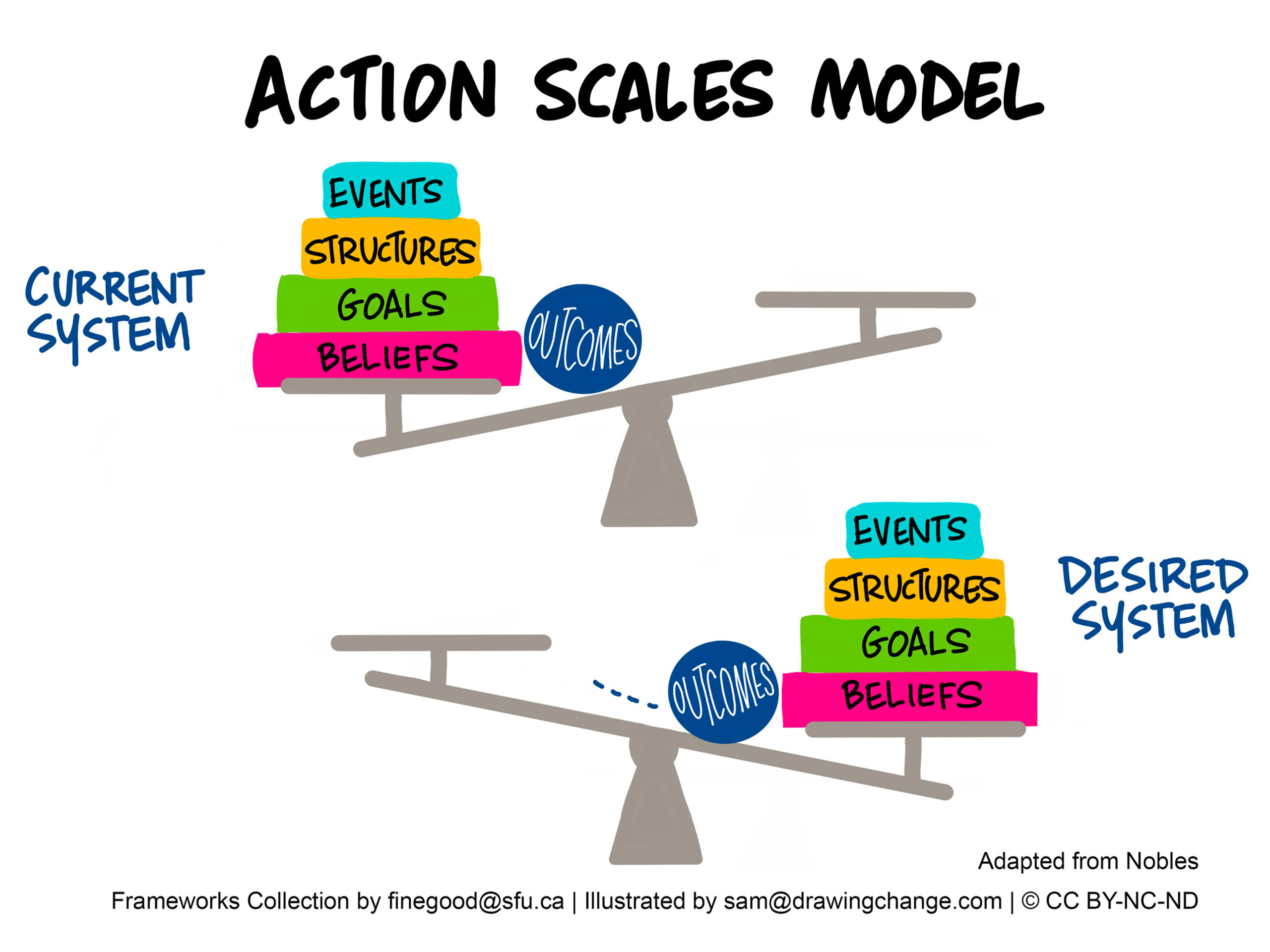
Фреймворк помогает лидерам осознанно управлять этой динамикой: понимать, когда конкуренция стимулирует инновации, а когда сотрудничество даёт бо́льший результат.Collaboration supports competitiveness at the next level up. Competition at one level encourages collaboration at the level below. Bar-Yam suggests that improvements to healthcare quality and cost would be enabled by empowering workgroup competition as an incentive. Just as team competition drives improvement in sports, competition between teams of care providers could enable improvement of healthcare outcomes especially for highly complex tasks.


Процесс выстраивания доверия описывает поэтапный путь от первоначального знакомства к глубоким, устойчивым отношениям, способным выдержать напряжение и неопределённость.Trust is the invisible engine that powers effective collaboration, especially in complex systems like healthcare and community development. Adam and Donelson’s process-based framework for building trust offers a practical and theoretically grounded roadmap for fostering sustained engagement and partnership.
Доверие строится постепенно через серию действий, подтверждающих надёжность, компетентность, честность и искреннюю заботу. Каждое взаимодействие либо укрепляет, либо разрушает доверие.The framework distinguishes between two levels of trust. Level 1 Trust is the initial stage, when relationships may be tentative, and interactions are often transactional. Individuals may collaborate, but their commitment may be limited and easily disrupted. Level 2 Trust is a deeper, more resilient form of trust where relationships are characterized by mutual commitment, shared goals, and a willingness to invest in long-term collaboration—even in the face of setbacks.
В контексте системных изменений доверие является фундаментом эффективного сотрудничества. Без него даже самые продуманные стратегии обречены на провал.At the heart of the process are three interconnected elements, each essential for moving from one level to the next:
Этот фреймворк помогает организациям и лидерам осознанно инвестировать в построение доверительных отношений как ключевого ресурса для коллективных действий.Reciprocity is the dynamic force that cycles through these three elements. As stakeholders work together, they engage in repeated cycles of giving and receiving—whether it’s sharing resources, knowledge, or appreciation. Each cycle builds confidence, reduces perceived risk, and strengthens the foundation of trust.


Концепция «Сила связей» основана на классической работе Марка Грановеттера (1973) о роли слабых и сильных социальных связей.Mark Granovetter’s influential 1973 theory, “The Strength of Weak Ties,” advanced how we understand social networks. Before Granovetter, sociologists believed that strong, close relationships like those with family and close friends were the most valuable. Granovetter showed that while strong ties are important for support and trust, it’s our weak ties— casual acquaintances and distant contacts—that often bring us new information and opportunities.
Сильные связи (close ties) — это глубокие, доверительные отношения с близкими коллегами и друзьями. Слабые связи (weak ties) — поверхностные знакомства с людьми из других кругов.Granovetter described the importance of the bridging function of weak ties that connect otherwise separate clusters of people, serving as crucial conduits for new ideas, resources, and opportunities. These bridges make it possible for information to travel further and faster across a network. The strength of ties is important in other frameworks, like the Collaboration Spectrum, which suggests that ties range from weak to strong in association with turf and trust.
Парадоксально, но слабые связи часто более ценны для распространения информации и инноваций: они соединяют разные социальные группы и приносят новые идеи.Granovetter highlighted how individual-level interactions (micro) could aggregate to produce broader societal patterns (macro), such as the diffusion of innovations, job opportunities, and even collective action. He also emphasized that the value of a social tie was not just about the number of connections (centrality), but also about the diversity and reach of those connections. Network theory formalizes these ideas in the form of nodes, and edges, and allows for numerical analysis of a network’s structure and properties.
В контексте системных изменений этот фреймворк помогает понять, как строить сети, способные как поддерживать глубокое доверие, так и обеспечивать широкое распространение идей.


Фреймворк «Доверие и сложность» исследует, как доверие функционирует в условиях неопределённости и непредсказуемости сложных систем.The image for this framework illustrates a central insight from Solomon and Flores’s, Building Trust: In Business, Politics, Relationships, and Life. Trust is not just a pleasant social virtue—it is the foundation that enables societies and organizations to thrive amid complexity.
Доверие снижает транзакционные издержки и позволяет системам действовать эффективно без необходимости детального контроля каждого взаимодействия.In high trust societies, trust acts as a powerful enabler: people are willing to form wide-reaching, cooperative partnerships. This willingness to engage, share, and collaborate allows for the creation of robust networks that can navigate complexity, uncertainty, and rapid change. High trust reduces the friction of social and economic interactions, making it easier for people to work together, solve problems, and innovate. As Solomon and Flores argue, trust is not static or automatic; it is an “emotional skill,” actively built and sustained through promises, commitments, and integrity.
В сложных системах доверие особенно важно, поскольку невозможно заранее предусмотреть все ситуации. Доверие создаёт «запас прочности», который позволяет системам справляться с неожиданностями.In stark contrast, in low trust societies relationships may be weak, and people are reluctant to cooperate. The result is fragmentation, economic disaster areas and places that are difficult to live in. Without trust in systems, the complexity of modern life can become overwhelming. People withdraw, avoid risk, and focus on self-preservation, which further erodes the social fabric. Solomon and Flores highlight that mistrust breeds insidious dynamics such as office politics or social suspicion that sabotage collective effectiveness and resilience.
Этот фреймворк помогает понять, как намеренно строить доверие на разных уровнях — межличностном, организационном и системном.As our world becomes more interconnected and reliant on relationships with “strangers” across cultures, organizations, and borders, the ability to build and sustain trust becomes even more crucial. High trust environments are better equipped to handle ambiguity, adapt to change, and seize new opportunities. Low trust environments, by contrast, are brittle: they struggle to cope with complexity and are prone to crisis and stagnation.


Модель двух петель описывает, как системные изменения происходят через сосуществование угасающей старой системы и нарождающейся новой.The Berkana Two-Loop Model, as described by Margaret Wheatley and Deborah Frieze, is a map for creating change in living and social systems. It illustrates the concept that change can intentionally be created by strategically using the concept of emergence.
Первая петля — существующая система, которая достигла пика и начинает приходить в упадок. Вторая петля — новые практики и структуры, медленно укрепляющиеся на периферии.The upper loop represents the existing system. All living systems go through a period in which they rise, peak, and then move into decline. Stewards of the existing system try to maintain the health of the system for as long as possible. As systems near their peak, signs of turbulence may appear, leading to decline. As decline continues, the need to provide hospice care grows. Hospice care can help the system end gracefully, making sure that as it declines, damage is minimized and learning is maximized. This is similar to the right side of the Adaptive Cycle.
В точке пересечения двух петель возникает наибольшая нестабильность и возможности для трансформации. Именно здесь новаторы и лидеры могут наиболее эффективно действовать.The lower loop illustrates how a new system can emerge from an old one. Turbulence in an existing system leads to “walk outs” from the old system. These innovators and trailblazers turn their backs on the existing system so they can create something new. Innovators tend to work in isolation, are invisible, and are mostly ignored. If they remain isolated, they may fail. But if the innovators are identified and connected, they can form networks and build trust to allow for a stronger base and a sharing of knowledge. When networks are nourished, they can become Communities of Practice. Connecting and nourishing these networks and communities is key to the growth of the new system. They are the fertile ground in which a new system can take root. If nourished enough, these networks and communities begin to share the knowledge of their successes—they illuminate what’s possible, becoming a system of influence. This is similar to the left side of the Adaptive Cycle.
Модель помогает практикам понять, где они находятся в цикле изменений, и выбрать соответствующие стратегии: поддержание, переход или создание нового.The transition from the old to the new is a critical phase where resources and people start to flow towards the innovations that have proven to be effective. It’s in this space that the old system can offer its resources to nourish the new system and help it grow.


Фреймворк выделяет различные типы доверия, необходимые для эффективного сотрудничества в сложных системах.Solomon and Flores (2003) identify four distinct types of trust that shape how individuals and organizations relate to one another. This language helps challenge the simplistic notion that trust is merely “earned”—instead, trust is seen as a dynamic, emotional skill that is actively built, maintained, broken, and sometimes restored.
Доверие к компетентности (competence trust): вера в то, что другой человек способен выполнить то, что он обещает. Доверие к честности (integrity trust): вера в то, что другой будет действовать в соответствии со своими ценностями.Simple trust is the most foundational and unreflective form of trust. It is often established in early childhood, forming the bedrock of our sense of security and optimism about the world. This trust is characterized by an absence of suspicion and a default belief that things (and people) are as they seem. It is unexamined, optimistic, and sometimes naïve, as depicted in the image—simple trust is our belief that the bag of chips contains exactly what is promised on the label. Simple trust is also innocent, uncritical, and automatic. It may provide a sense of safety and stability, especially in familiar or lower-risk situations, but it is vulnerable to betrayal or disappointment, as it does not account for the possibility of deception or error.
Доверие к доброй воле (benevolence trust): вера в то, что другой искренне заботится о вашем благополучии. Системное доверие (systemic trust): доверие к институтам, правилам и структурам.Blind trust is trust that persists even in the face of evidence that trust may not be warranted. It is uncritical, unverified, and absolute—often resembling denial. This form of trust is willful; individuals sometimes ignore clear warning signs that their trust is unwarranted and often choose not to question or investigate the circumstances. Blind trust requires willful self-deception and a denial of contrary evidence. It can foster strong group cohesion and loyalty, but it is highly dangerous because it leaves individuals and groups open to manipulation, exploitation, or harm.
Понимание разных типов доверия помогает диагностировать, какого именно доверия не хватает в конкретных отношениях или системе, и целенаправленно работать над его восстановлением.Cordial hypocrisy is the pretense of trust layered over underlying distrust. It is common in professional and social settings where maintaining appearances is prioritized over genuine connection. This type of trust is superficial, insincere, and serves as a facade to avoid conflict or discomfort. It helps avoid open conflict in the short term, but it erodes genuine trust over time, creates a toxic environment, and makes authentic collaboration extremely difficult.
Authentic trust is the most mature and resilient form of trust. It is earned, mutual, and resilient. It is built through honest communication, negotiation, and a willingness to confront and work through breaches or disappointments. People in relationships of authentic trust are fully aware of the risks and limits of that trust, and it remains conditional upon ongoing integrity and accountability. It enables deep collaboration, innovation, and the freedom to take risks together, but requires ongoing effort, vulnerability, and the courage to address conflict openly.
Solomon and Flores argue that while we often begin with simple or basic trust, and sometimes slip into blind trust or cordial hypocrisy, the goal should be to cultivate authentic trust. Authentic trust is not static; it is a living process that requires honesty, negotiation, and a willingness to address the complexities and challenges inherent in all relationships.